


The first year of FuelEU Maritime implementation marks a major milestone in the European Union’s decarbonisation strategy for shipping. During the 2025 reporting period, companies monitored onboard fuel consumption and energy use, laying the foundation for the first compliance cycle under the Regulation. According to information published by the European Commission and EMSA, more than 13,000 FuelEU Maritime reports were verified between January and March 2026. More than 12,000 compliance balance reports, representing over 90% of the fleet, were verified as satisfactory, while around 90% of vessels made use of the pooling mechanism. These results demonstrate strong industry engagement and the importance of the flexibility mechanisms embedded in the Regulation.
KICKSTER FuelEU marketplace assessment highlights fleet readiness after FuelEU Maritime’s first reporting year. Independent EU MRV-based analysis complements official first-cycle results and provides a transparent benchmark for relative compliance readiness.

“The first year of FuelEU Maritime has shown that digitalisation, transparency and collaboration are
essential for compliance. Our independent FuelEU Readiness Proxy provides shipowners and charterers
with an additional market intelligence tool to benchmark their fleets and identify opportunities for
optimisation. It complements—not replaces—the official FuelEU compliance process.” Declared Pietro
Valaguzza, CEO of KICKSTER Group.
Independent Market Assessment
In parallel with the official implementation process, KICKSTER FuelEU Marketplace completed an
independent assessment of the public EU MRV dataset to evaluate the relative FuelEU readiness of the
European fleet. The analysis is designed to benchmark relative fleet readiness where ship-level official
FuelEU compliance data are not available in the MRV data.
Methodology
The assessment developed a FuelEU Readiness Proxy because official FuelEU compliance variables
(well-to-wake GHG intensity, compliance balances, pooling allocations, banking and borrowing) are not
included in the EU MRV dataset.
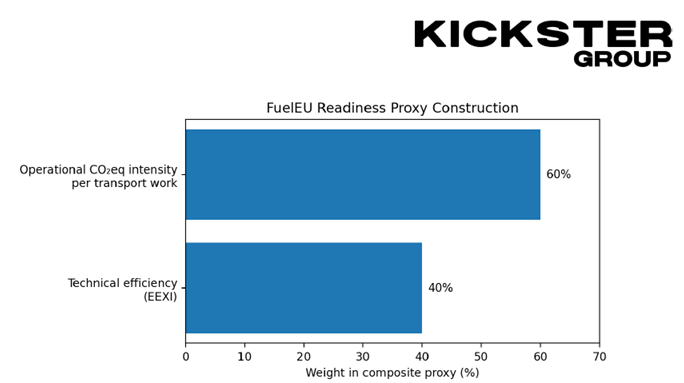
The proxy combines technical efficiency (EEXI) and operational CO₂ intensity per transport work using a weighted score (40% EEXI, 60% operational performance). Records with incomplete information and
statistical outliers were excluded to improve robustness.
Only records with an identifiable EEXI and a positive operational-intensity value were included. The
highest 1% of each variable was excluded to limit the influence of reporting anomalies. Both indicators
were converted into percentile ranks and combined into a 0–100 relative-risk score. Lower scores indicate stronger relative readiness. The class boundaries are analytical benchmarks, not statutory FuelEU thresholds. The methodology is intended for benchmarking and comparative analysis rather than reproducing official FuelEU calculations.
KICKSTER proxy results

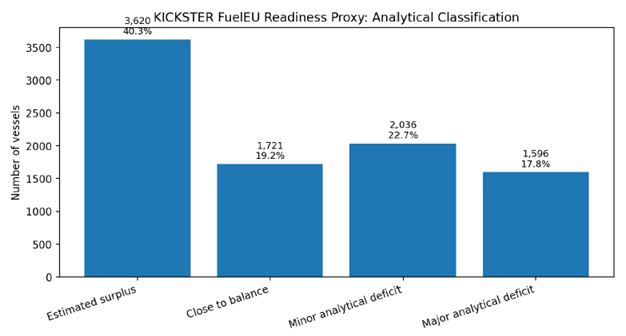
The proxy analysis included 8,973 vessels after applying the stated eligibility and outlier rules. The
correlation between EEXI and the selected operational-intensity indicator was 0.413, indicating a positive but incomplete relationship between technical and operational efficiency. Under the analytical
classification, 3,632 vessels (40.5%) fell into the combined minor or major analytical-deficit categories.
These are relative risk categories and must not be described as verified regulatory deficits.
Key Results
- Moderate positive correlation between EEXI and operational emissions performance.
- Most analysed vessels demonstrated characteristics associated with low FuelEU compliance risk.
- Technical efficiency alone is insufficient to explain FuelEU performance; operational practices and
fuel choice remain decisive. - The methodology provides a transparent benchmark for fleet readiness using publicly available
information.
What the first FuelEU cycle tells the market
Implementation has scaled quickly
More than 13,000 reports were verified in the initial verification window, while more than 12,000
compliance balances covering over 90% of vessels were satisfactory by 30 April 2026.
Flexibility mechanisms are already central
Pooling was reportedly applied by 90% of vessels. This indicates that compliance strategy is not only a
vessel-level fuel decision; it is also a portfolio and market-coordination exercise.
Efficiency remains relevant, but it is not compliance
KICKSTER’s proxy finds a positive relationship between EEXI and operational emissions intensity.
However, official FuelEU performance is ultimately driven by well-to-wake energy intensity and the use of regulatory flexibility mechanisms.
Marketplaces can reduce coordination friction
A transparent marketplace can help connect compliance surplus and deficit positions, support price
discovery, and give participants a clearer view of available strategic options, subject to verified regulatory data and contractual controls.
Disclaimer
This assessment is an independent analytical exercise. It should not be interpreted as an official FuelEU
Maritime compliance determination. Actual compliance is calculated under Regulation (EU) 2023/1805
using verified well-to-wake greenhouse gas intensity values and the Regulation’s compliance
mechanisms.
Sources
- Official implementation figures: European Maritime Safety Agency, EMSA Newsletter No. 250, May 2026, “FuelEU Maritime: A strong first year of reporting and verification.”
- Regulatory context: European Commission, “Decarbonising maritime transport – FuelEU Maritime.”
- KICKSTER proxy figures are calculated from the supplied 2025 EU MRV publication workbook and are independent analytical estimates.
Disclaimer: Official FuelEU compliance is determined under Regulation (EU) 2023/1805 using verified
well-to-wake greenhouse-gas intensity and the applicable compliance mechanisms. The KICKSTER
proxy is not a substitute for verification, a FuelEU document of compliance, or a compliance balance
calculation.
How to report KICKSTER’s findings accurately
- Use “FuelEU Readiness Proxy” or “analytical readiness classification.”
- Do not call proxy deficit categories official FuelEU deficits.
- State that the proxy is based on EEXI and operational CO₂eq intensity in the public EU MRV dataset.
- Note that verified fuel pathways, well-to-wake intensity, banking, borrowing and pooling allocations are outside the proxy.


