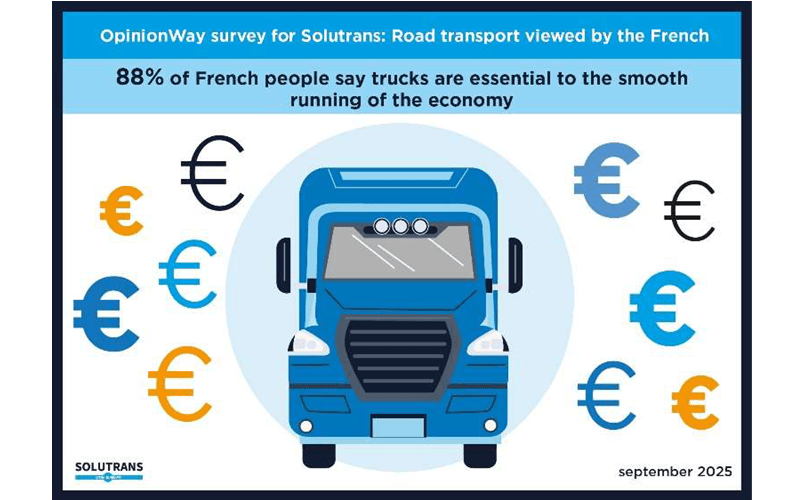
OPINIONWAY SURVEY FOR SOLUTRANS: “ROAD TRANSPORT VIEWED BY THE FRENCH”
To mark the 180th anniversary of the French Bodywork Federation (FFC), Solutrans enlisted the services of OpinionWay to gain a better understanding of French attitudes to road freight transport. A survey was conducted in September 2025 with a dual goal: measure the image and perception that the French have of these vehicles that are ubiquitous in their everyday lives, and gauge their expectations, notably in the
areas of ecological transition and safety.
The survey highlights the unavoidable role of trucks in the lives of the French and in the country’s economy but also reveals a persisting lack of awareness of the environmental and social advances achieved by the sector.
TRUCKS, ESSENTIAL ASSETS FOR EVERYDAY LIFE IN FRANCE
Light commercial vehicles have a generally positive opinion rating among French people (70%, including 79% of the 25-34 age range). Lorries also receive the approval of 62% of the population, with higher ratings among young adults aged 18-24 (76%). This level of appreciation provides confirmation that the image of trucks is becoming more modern and winning over young people.
A clear majority believe that road freight transport is essential for smooth running of the economy (88% of French people). The French see road transport as a rapid and flexible means of delivery (44% including 52% of 18-24s, tying in with what they expect in society), and as playing an essential role in the supply chain of their products (94%).
Furthermore, the survey reveals that trucks also contribute to equality between regions. Indeed, they receive the approval of 81% of inhabitants of rural zones and 85% of people living in population centres with under 20,000 inhabitants, where they contribute to maintaining equitable access to goods and services.
A KEY PLAYER FOR THE FUTURE
The French offer a very clear opinion: they believe that trucks are unavoidable. Nearly eight out of ten say that they could not do without them for goods deliveries in France (78%, including 36% of “definitely not”).
Some sectors in particular appear highly dependent on truck transport.
A majority of French people believe certain products cannot be delivered with any other means of transport;
categories such as:
– Products purchased online for home delivery (60%),
– Pharmaceutical and medical products (63%),
– Transportation of waste (76%),
– Stocks of goods transported to supermarkets (77%),
– Raw materials for building sites (79%).
These findings offer proof that trucks remain an unavoidable link in the logistics chain through their flexibility and propensity to cover all parts of the country.
The French associate trucks and light commercial vehicles with local transportation: journeys of under 100 km, with a significant concentration in trips between 10 and 50 km (87%). Even for distances of 100 to 500 km, trucks (44%) compete with rail (45%) as the best means of transport.
For shorter distances, the French acknowledge several advantages offered by road transport, the first two of which are its ability to reach remote regions (66%) and the rapidity of transport (63%). Schedule flexibility (37%) and cost effectiveness (21%) are lesser convincing arguments for the respondents. Some mention more macroeconomic benefits such as job creation (35%) or contributions to exports (24%).
A SECTOR WITH LOW PUBLIC AWARENESS
However, the French still appear to lack information and knowledge on road transport, whether in terms of its impact on society, its innovations or its environmental initiatives. This can be seen through the prevalence of some cases of received wisdom, and through clear splits in opinion.
For instance, nearly eight out of ten people believe that the lorries travelling on the roads of France are most often in transit between two other countries (78%). The French are divided on the question of whether or not road freight transport is a major source of road accidents (51% say true, 49% say false).
More generally, the sector’s improvement efforts are still not very visible to the public. Only six out of ten French people say that road transport businesses take measures to reduce their environmental footprint. Among these efforts, reducing noise pollution is the most appreciated (59%). Actions to improve road safety, improve drivers’ working conditions or modernise the image of the sector are also recognised (65 and 67%).
Moreover, the trucking profession lacks recognition from society, a fact underlined by 78% of French people. However, 84% believe the sector is actively hiring, providing many career opportunities, and 83% observe that it is becoming increasingly open to women, the sign of a gradual transformation towards greater diversity and the modernisation of the profession’s image.
Finally, the survey’s respondents call for greater visibility of the innovations transforming the sector, whether these be ecological solutions or measures to improve safety.
Only 34% of the survey sample say that they are well-informed about new energy sources that can help make transport greener – in the 18-24 age group, this figure is 64% (compared with 21% in the 65+ group).
Similarly, only 41% say that they have heard about initiatives to protect drivers and users, a perception that is higher among the 25-34 age
range (58%, compared with 33% of the 65 and over group).
These disparities show that information circulates more to younger generations, who are seen as more sensitive to the issues of
innovation and transition, but they also show that the sector needs to communicate better to reach everyone in the population.
HIGH EXPECTATIONS OF GOVERNMENT
French people say that they expect a lot from government authorities to support the green transition in the road transport sector: 79% say that central government must play a leading role.
Among the solutions mentioned, 70% say that using high-capacity (25.25m) vehicles could contribute to bringing down carbon emissions while improving road safety and driver working conditions.
When asked whether trucks should benefit from their own lanes on motorways to reduce pollution or expedite deliveries, 77% of the French are in favour.
But this responsibility is not just one for government authorities. The French say that they are also prepared to change their consumer
behaviour to support more sustainable and responsible transport. Indeed, 78 % are ready to accept longer delivery times than those observed today, even if 70% do not want to see costs rise in
parallel. These figures show a willingness to reconcile practicality and environmental commitment, provided that a cost balance is
maintained.
While the French want to know more about the sector’s innovations and environmental actions, they declare their confidence and their readiness to support a more sustainable road transport sector. Thanks to the combined commitment of transport professionals and government authorities, the future of the sector is shaping up to be more responsible, safer and with a resolute focus on the green transition.
Survey methodology
The survey “Road transport viewed by the French” carried out for Solutrans was conducted among 1,085 individuals representative of the French over-18 population according to the quota method in terms of gender, age, social and professional category, population centre category and region of residence.